

Known worldwide for its Grands Crus, Vosne-Romanée produces red wines synonymous with elegance and complexity, and its village and premier cru appellations are also highly sought after.
This small village was called Vosne until the arrival in 1760 of the Prince de Conti, who purchased a Grand Cru plot known as Romanée. The famous Romanée-Conti was born, and this wine—which would go on to become legendary—would bring prestige to the entire village.
The Vineyard
Located between Nuits-Saint-Georges and Vougeot, the Grand Coteau enjoys an extremely sheltered location and ideal exposure, contributing to the perfect ripening of the grapes harvested there. At the heart of the hillside lie the Grands Crus, covering nearly one-third of the 226 hectares of vineyards. Of the eight Grands Crus that make up the Vosne-Romanée “collar,” six are clustered just above the village. Les Echezeaux and Les Grands Echezeaux, located within the territory of Flagey-Echezeaux, are classified as Grand Crus of Vosne-Romanée under wine legislation.
It was not until 1866 that Napoleon III, by imperial decree, authorized the wine-producing communes of the Côte to add to their names that of the finest Grand Cru within their boundaries. Romanée was naturally added to Vosne. This prestigious appellation, which produces only red wine, is actually divided between two communes: Vosne-Romanée and its neighbor Flagey-Echézeaux—located on the plain, but whose vineyards extend all the way up to and beyond the Clos-Vougeot.
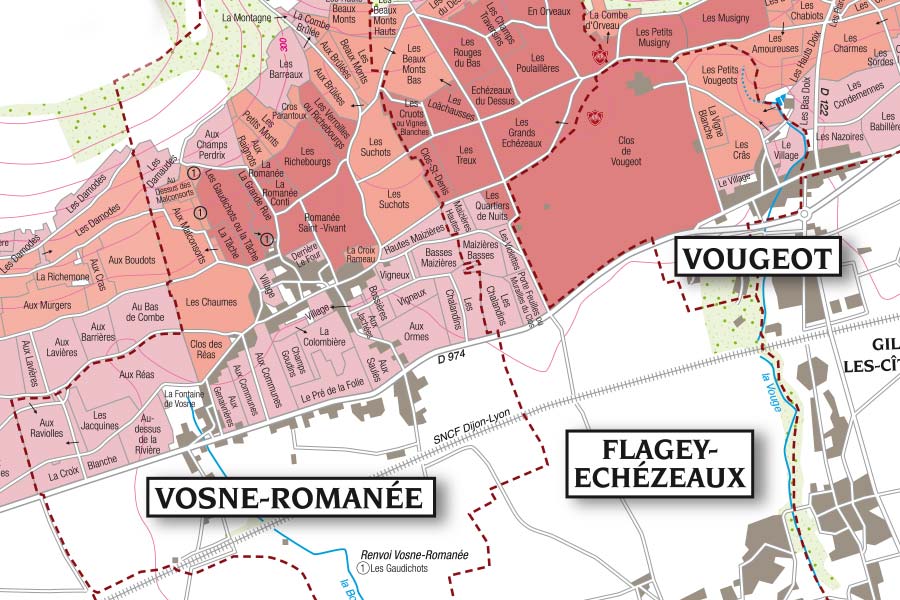

Here are the eight gems of the collection: the Romanée-Conti, that legendary Grand Cru covering an area of 1.81 hectares, guarded by a solitary cross erected in 1804 and partially walled, has carried its history for nearly eight centuries since the monks of Saint-Vivant Abbey planted the first Pinot Noir vines there. It gave its name to the estate that cultivates it exclusively. The work of the Domaine de la Romanée-Conti borders on perfection, which is reflected in the quality of this extremely rare wine, such as the 1999 vintage. La Romanée extends upward from Romanée-Conti along a steeper slope. For a long time, this Grand Cru formed a single entity with its neighbor and definitively acquired its name in 1827 after Louis de Liger-Belair received it as a dowry. With its 0.85 ha, it is today the smallest AOC vineyard in France. The Liger-Belair family has retained exclusive rights to it. The Romanée Saint-Vivant covers a much larger area of 9.44 hectares. Nestled between Richebourg and the village, this appellation serves as a reminder that the Abbey of Saint-Vivant, located on the inner slope, once owned vineyards in Vosne. La Grande Rue takes its name from the road that runs along this long, narrow parcel on one side and the Romanée, Romanée-Conti, and Romanée Saint-Vivant on the other. This 1.65-hectare climat was not elevated to Grand Cru status until 1990; it is a monopoly of the François Lamarche estate. Deriving its name from the payment system for “day laborers,” La Tâche is a monopoly of the Domaine de la Romanée-Conti. It covers 6.06 hectares of perfectly homogeneous terroir that produces sumptuous wines vintage after vintage, as perfectly illustrated by the 2006 La Tâche Grand Cru magnum.
Le Richebourg, which overlooks the Romanée Saint-Vivant, enjoys a superb location that is reflected in its highly coveted wines, such as those of the late Henri Jayer. This Grand Cru spans 8.03 hectares, and its vines climb to an altitude significantly higher than that of its neighbors. The mystery of its etymology remains. Les Grands Echézeaux is located above the western wall of the Clos de Vougeot on a homogeneous terroir of 9.14 ha. Its name likely refers to the ruins of ancient dwellings. Comprising no fewer than 11 lieux-dits, the Echézeaux (36.26 ha) is the largest Grand Cru in the Côte de Nuits after the Clos de Vougeot. The 2018 Echézeaux Grand Cru from Château de Marsannay perfectly expresses this magnificent terroir.
Whether they are commune-level wines, such as the Vosne-Romanée Joseph Faiveley, Premier Cru wines like the excellent En Orveaux climat from Château de Marsannay, or Grand Cru wines, the wines of Vosne-Romanée share an incredible finesse, silky tannins, and a very broad aromatic palette centered on red fruit. Some Grands Crus border on perfection and possess exceptional aging potential.
While wine is the main attraction of this village, Vosne-Romanée also boasts some truly fascinating architectural landmarks. Among them are the so-called Maison Romane, dating from the 16th century, where a Protestant consistory was held in 1607, and the Pavillon de la Goillotte, formerly a hunting lodge for the Dukes of Burgundy and later a wine cellar for the Princes of Conti. Not to mention the interior woodwork of Saint-Martin Church, brought to Vosne-Romanée by Dom Trouvé, the last abbot of Cîteaux Abbey, where it had adorned the Chapter House before the Revolution. The Château de Vosne, located in the heart of the village, was remodeled in the 19th century and is owned by Count Liger-Belair; it, too, is an integral part of Vosne-Romanée’s cultural heritage.
It therefore seems inconceivable to visit Burgundy without stopping to pay one’s respects to His Majesty Vosne-Romanée!
