



The Marché aux Vins is located in the former Cordeliers church, built in the 14th century. Today, only 3 chapels and a few arches remain in this 500 m² space, which houses more than 1,500 Burgundy wine references.
Since 1976, the Marché aux Vins has welcomed visitors for Burgundy wine tastings in its cellars.
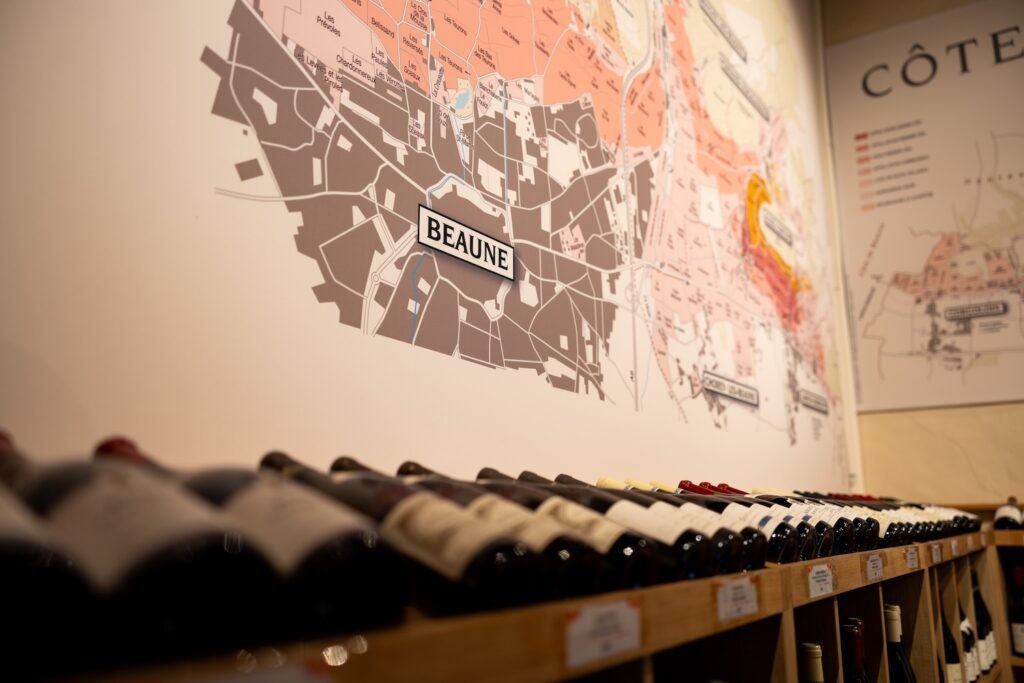
In 2014, Olivier Halley and his team opened the Cordeliers church to passers-by, enriching the experience with an educational approach. The chapels are showcased, and large maps of the Côte d’Or appellations adorn the walls of the church.
Burgundy is made up of 4 vineyard areas: Chablis, the Côte d’Or, the Côte Chalonnaise and the Mâconnais. The Côte d’Or occupies a place of choice, both for its renown and its geographical position. Made up of the Côte de Nuits (to the north) and the Côte de Beaune (to the south), the Côte d’Or is home to 32 of Burgundy’s 33 grands crus. The Côte de Nuits is the cradle of the greatest red wines, while the Côte de Beaune is home to the most prestigious climats planted with Chardonnay.
In the year 1239, a procession of monks was travelling back up towards Paris, escorting the Crown of Thorns of Christ. On arriving in Beaune, one of the Franciscan monks, Valérien, fell ill and, unable to continue his journey, settled with another brother in the guardhouse of the Bellevent gate, located in what is now the rue de l’Hôtel Dieu. Named Cordeliers because of the corded belt tied around the waist of these monks, the order was founded by Francesco Bernardone, better known as Saint Francis of Assisi.
On 15 July 1246, Pope Innocent IV gave his approval for the founding of a Franciscan convent in Beaune. While the day and month construction of the church began are known, the year remains a mystery.
Most historians agree that it was built between the late 13th and early 15th century. This church, dedicated to Saint Bernardino, was very tall and its bell tower rivalled that of the Hôtel-Dieu. Its entrance door, which faced north, would today be aligned with the rue de l’Hôtel-Dieu.
Numerous fragments of tombstones were found during excavations, evidence of the devotion of the people of Beaune and the surrounding region towards the Franciscan friars. These burials were acts of piety and charity, as they involved the donation of a large part of one’s estate. In return, the Franciscan friars would pray for the benefactor’s salvation.
Nicolas Rolin founded the Hospices de Beaune in the early 15th century, and the Franciscans gave up part of their land to the Hospices in exchange for a room for sick monks.
It was in the mid-15th century that Nicolas Rolin founded the hospital, the Hospices de Beaune. The Franciscan friars gave up part of their gardens and land to the north in exchange for a room reserved for sick Cordeliers friars. It was kept for them until the last Franciscan monk died.
The Order of the Cordeliers in Beaune declined over the course of the 18th century, and the church disappeared when the clergy’s property was seized during the French Revolution.
The rue de l’Hôtel Dieu was opened in 1803, removing the nave and separating the convent from the chapels.
The Cordeliers church was used as a grain hall, a stable, a warehouse, a tinsmith’s workshop and a car garage before being rediscovered in the early 1970s. These 3 intact chapels are the highlight of a visit to this historic site, now devoted to wine tasting. Since it opened in 1976, its ties with the Hospices de Beaune have been renewed, with the Marché aux Vins remaining a loyal buyer of Hospices de Beaune wines for more than 35 years.
