
The village and Premier Cru wines of Aloxe-Corton, as well as the Corton Grand Cru, are generally red. However, the white Grand Crus of Corton-Charlemagne and Corton also contribute to the fame of this renowned hill.
The village of Aloxe is built on a small hill at the very foot of the Corton mountain, whose name—added to its own in 1862—has brought it fame. A few beautiful buildings, such as the Church of Saint-Médard, Grancey Castle, and Corton-André Castle—whose gleaming roof catches the eye from the highway—lend the village its prestige and true Burgundian charm.
Other notable landmarks in Aloxe-Corton include the Cross of Charlemagne and the small grove at the top of the hill, which resembles a monk’s tonsure. Covering an area of 66 hectares and planted with ash, beech, oak, and chestnut trees, and reaching an altitude of 388 meters, this grove crowns one of the most famous hills in the world, overlooking the three villages of Aloxe-Corton, Ladoix-Serrigny, and Pernand-Vergelesses.
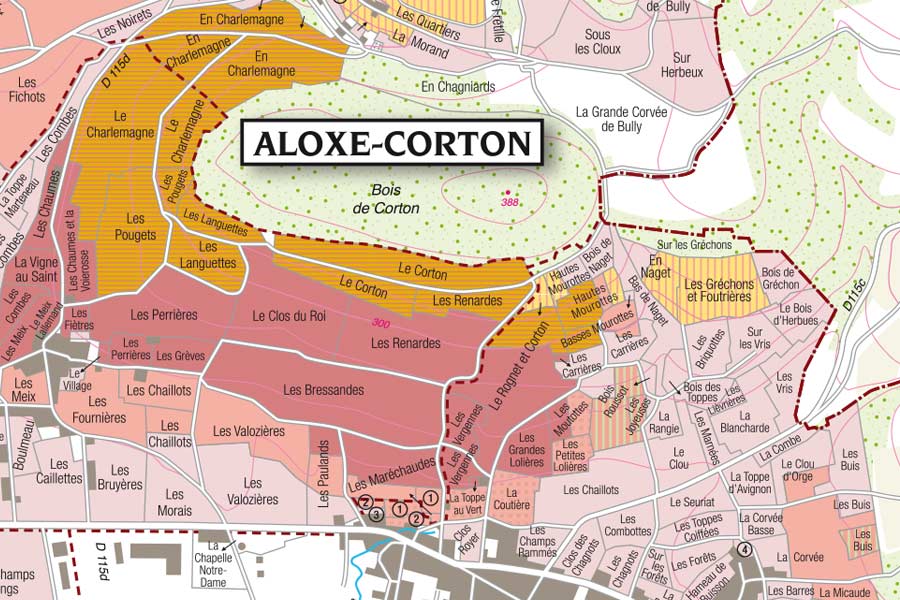

The slopes of Corton Hill are home to 167 hectares of vineyards classified as Grands Crus, which produce the Pinot Noir and Chardonnay wines of the Corton and Corton-Charlemagne appellations. In 775, Emperor Charlemagne donated a vineyard he owned on the Corton hill to the Collegiate Church of Saint-Andoche in Saulieu. Legend has it that he had it replanted with white grape varieties to avoid the conspicuous stains that red wine too often left on his flowered beard. This Clos Charlemagne constitutes the historic core of the cru, which expanded outward to encompass the current climats Le Charlemagne (Aloxe-Corton) and En Charlemagne (Pernand-Vergelesses). The Corton-Charlemagne Grand Cru, covering an area of 72 hectares (49 of which are in the commune of Aloxe-Corton), extends well beyond these boundaries. Straddling the three communes of Aloxe-Corton, Ladoix-Serrigny, and Pernand-Vergelesses lies the third prestigious Grand Cru, the Corton, which excels in both red and white wines. As the only red Grand Cru in the Côte de Beaune, it boasts a deep color and a remarkable balance between structure, power, and elegant freshness, as exemplified by the Corton “Cuvée Charlotte Dumay” from the Hospices de Beaune. The white Grands Crus of Corton, Charlemagne, and Corton-Charlemagne are recognizable by their intense golden color, even when young. Their aromatic power, extraordinary freshness, and intensity and length on the palate are remarkable. The 2018 Corton-Charlemagne from Domaine Dubreuil-Fontaine is a perfect example of this.
One-third of the vineyards in the Aloxe-Corton appellation are classified as Premiers Crus; its vineyards stretch across the villages of Aloxe-Corton and Ladoix-Serrigny and form a bridge between the Côte de Nuits and the Côte de Beaune. The appellation boasts no fewer than 14 Premiers Crus, the most renowned of which are Clos des Maréchaudes, Les Valozières, and Les Fournières.The Aloxe-Corton Premier Cru Les Maréchaudes from Château de Meursault is a fine example of this.
The wines of the Aloxe-Corton village appellation are predominantly red. They are, on the whole, colorful, powerful, elegant, and suitable for aging, with some variation depending on the nature of the soils. The northern part, with its stony soils, produces soft, fruity wines; the southern part, with its clayier and marly soils, yields more robust, firm, and structured wines that never lose their distinct character. The white wines, which are less well known, are supple and full-bodied, with a spicy and mineral bouquet in their youth that evolves into subtle aromas of brioche, hazelnut, and honey.
Let yourself be charmed by this lovely village, rich in cultural heritage, where the traditional Burgundian architecture is matched only by the exceptional quality of its wines. Treat yourself to a lovely stroll through these legendary vineyards, where you’ll discover breathtaking scenery!

